 Shinechip
Stair Lighting Controllers
Stair lighting controllers light each step in sequence as someone approaches, so stairs are safer at night without every step staying lit. Supply complete stair kits with controller, strip and power supply from one source.
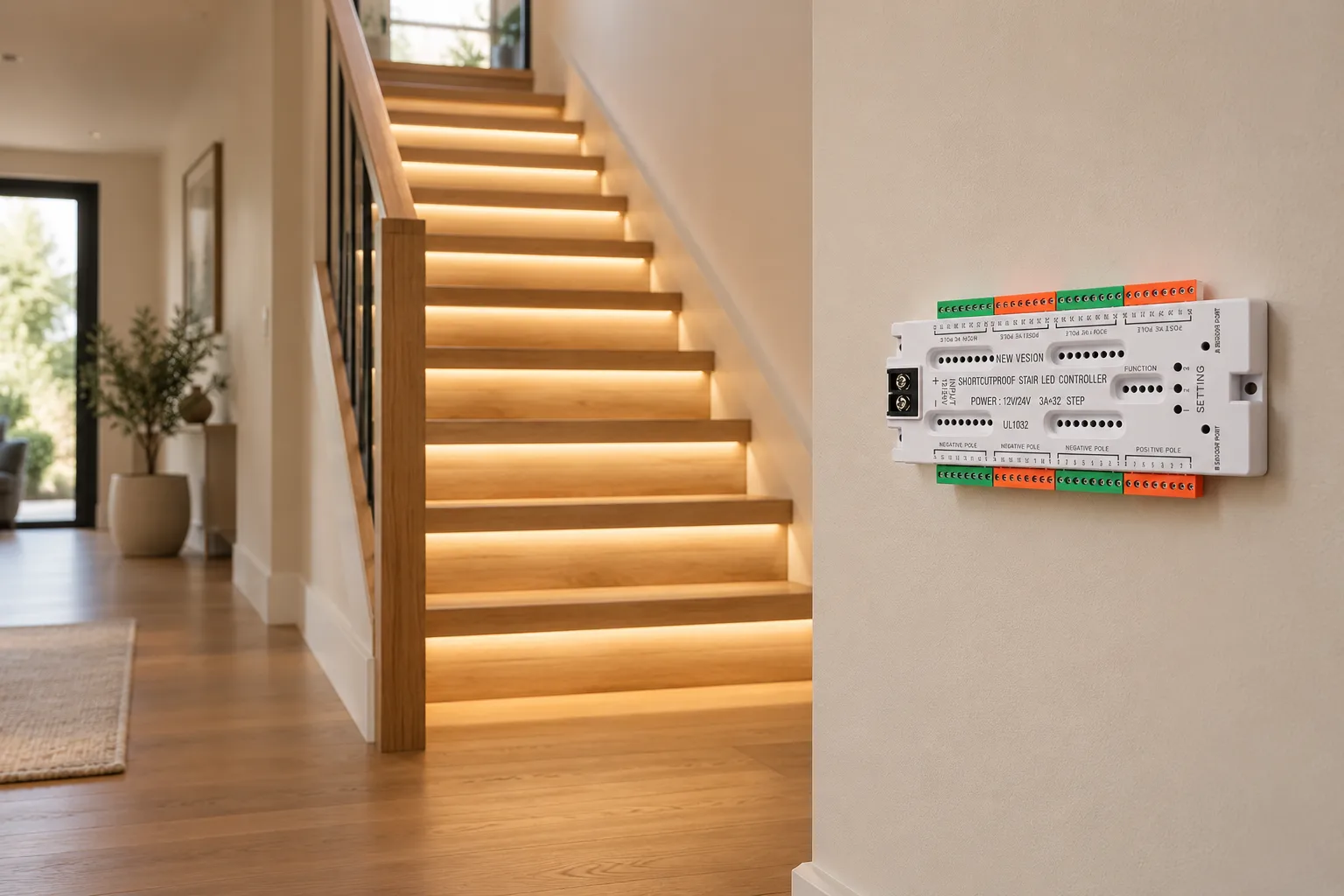
Stair lighting controllers make a staircase safer to use at night without leaving every step lit. Sensors detect someone approaching and the controller switches the step lights in sequence. They suit stair and joinery makers, lighting installers and distributors supplying complete stair kits. This page lists the UL1032 and V2-STEP-1002 for up to 32 steps, and a 1-channel 30A controller with an RF remote, all for 12V or 24V DC strips.
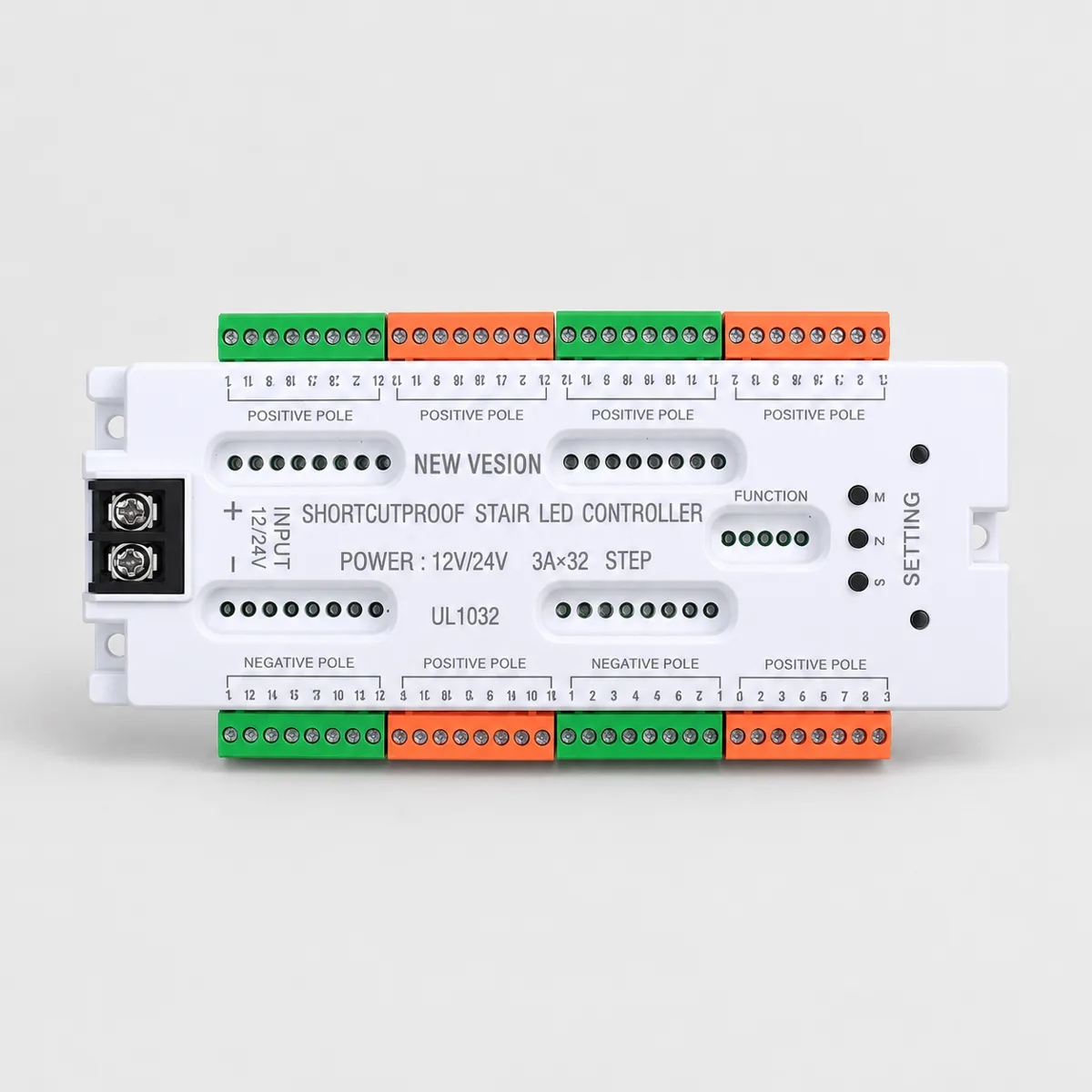 FeaturedUL1032
UL1032 32-Channel Stair Lighting Controller, 12/24V DC
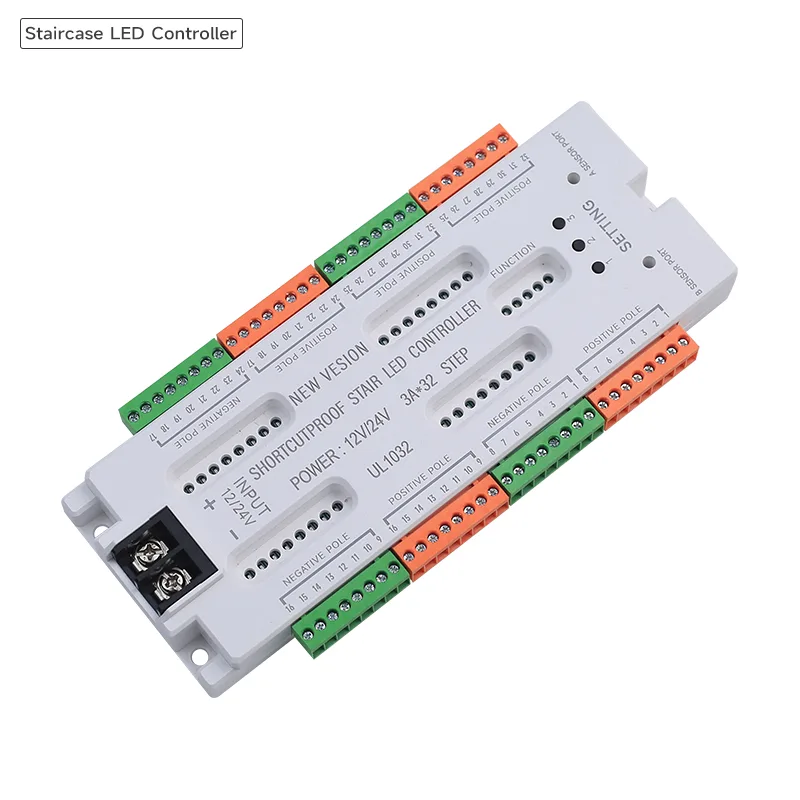 Featured
V2-STEP-1002 32-Step Stair Light Controller with Remote, 500W
Why buyers source stair controllers from us
The UL1032 and V2-STEP-1002 handle staircases of up to 32 steps.
A 1-channel 30A controller with an RF remote covers projects that need adjustable brightness.
All models run 12V or 24V DC strips. Mix controllers with strip and drivers in one order, shipped in 7-15 days.
How to choose
- Count the steps: the controller must have enough channels.
- Use sensors at the top and bottom so the lights run in the walking direction.
- Size the power supply for all steps lit at once.
Building a stair & step? See the complete Stair & Step kit →
Send these details for a quote
- Number of steps and the width of each step
- Strip voltage (12V or 24V DC) and strip watts per metre
- Step-by-step sequence or all steps together
- Sensor positions and distance from the sensors to the controller
- Whether a remote is required
- Controller location and cable lengths to the first and last step
- Quantity of kits
Related articles
How it is wired
How is a step lighting system wired?
A sequential stair system has four parts: a constant-voltage power supply, the controller, one LED strip per step and two sensors. The supply feeds the controller, each controller output runs to one step, and the sensors connect at the top and bottom of the flight. The UL1032 is listed with 32 channels and the V2-STEP-1002 with 32 steps, so one controller covers a flight of up to 32 steps.
Label every step cable at both ends during first fix. Sequence errors after the walls are closed are almost always caused by outputs connected in the wrong order.
The 1-channel 30A controller works differently: it switches and dims all the stair strips together as one circuit, controlled by its RF remote. Choose it when the stair needs dimmable light but not the step-by-step effect.
How do I size the power supply and controller load?
First find the load of one step: strip watts per metre multiplied by the strip length on that step. Multiply by the number of steps to get the load with all steps lit, which is the figure the supply must cover.
The 1-channel controller is listed at up to 360W on 12V and up to 720W on 24V. Both figures correspond to its 30A rating: 30A x 12V = 360W and 30A x 24V = 720W.
The V2-STEP-1002 is listed at 500W. If that is the total for all outputs, a 32-step flight averages 500W ÷ 32 ≈ 15.6W per step. Confirm with us whether the rating is total or per channel before sizing long steps, and check the strip's datasheet for watts per metre.
Each step cable only carries that step's current, which is the step watts divided by the strip voltage. The supply cable to the controller carries the sum for all steps lit together, so size that cable and its terminals for the full load rather than for a single step.
Where should the sensors be mounted?
Place one sensor at the foot of the stair and one at the head, aimed along the direction of approach so it sees a person before they reach the first step. The UL1032 is listed with a sensing range of 1-3 m. Avoid aiming a sensor across a hallway where people pass without using the stairs, or the lights will run with nobody on them.
The UL1032 is listed at IP22, so keep the controller in a dry, ventilated position, such as a cupboard under the stair, with access for later service.
What mistakes cause problems on stair lighting jobs?
Common errors are a supply sized for one step at a time instead of all steps lit together, a 12V strip on a 24V supply, more steps than the controller has channels, and long unshielded sensor cable runs laid next to mains cable. Check each step strip works before fitting the stair nosings.
What can be specified on OEM orders?
Tell us the number of steps, the strip voltage, the width of each step and whether you need a remote. We confirm which controller fits and what can be supplied with it, such as sensor cables and step leads cut to your lengths.
Compare by type
| Type | How it is triggered | Suited to | Typical models |
|---|---|---|---|
| Sequential step controller, sensor operated | Motion sensors at the top and bottom | Staircases of up to 32 steps with step-by-step lighting | UL1032 |
| Sequential step controller with remote | Remote control; confirm the sensor inputs for your stair | Up to 32 steps where settings are changed by remote | V2-STEP-1002 |
| 1-channel stair dimmer | RF remote | Stairs lit as one circuit, dimmable | 1-Channel 30A Stair Step LED Controller |
Compare stair controllers
| Model | Input | Max load | Range / size | MOQ |
|---|---|---|---|---|
| UL1032 32-Channel Stair Lighting Controller, 12/24V DC | 12/24V DC | - | 1-3m(3.28-9.84ft) | 1 sets |
| V2-STEP-1002 32-Step Stair Light Controller with Remote, 500W | - | 500W | - | 2 pcs |
Values from our Alibaba.com listings. Ask us to confirm the exact version before ordering.
Frequently asked questions
How does a stair lighting controller work?
Sensors at the top and bottom detect a person and the controller lights the steps one after another, then turns them off in the same order.
Can it work only at night?
Some models include a light sensor so the stair lights only run when it is dark. Check the product page.
Which LED strip should I use for steps?
A low-voltage 12V or 24V strip cut to the width of each step, one channel per step.
Can one controller run a flight with fewer than 32 steps?
Yes. The UL1032 and V2-STEP-1002 are listed for up to 32 steps, so a shorter flight uses fewer outputs. Tell us the step count and we confirm how the unused outputs are handled.
Can the stair lights be dimmed?
The 1-channel 30A controller dims all steps together from its RF remote. For the sequential controllers, ask us which brightness settings the model supports.
Need a stair controller for your project?
Send the switch type, voltage, load and quantity, or a photo of the switch you use today. We reply with model options, MOQ, price and lead time.