 Shinechip
How to Connect Multiple LED Strip Lights
Published 2026-10-09 · Shinechip engineering team
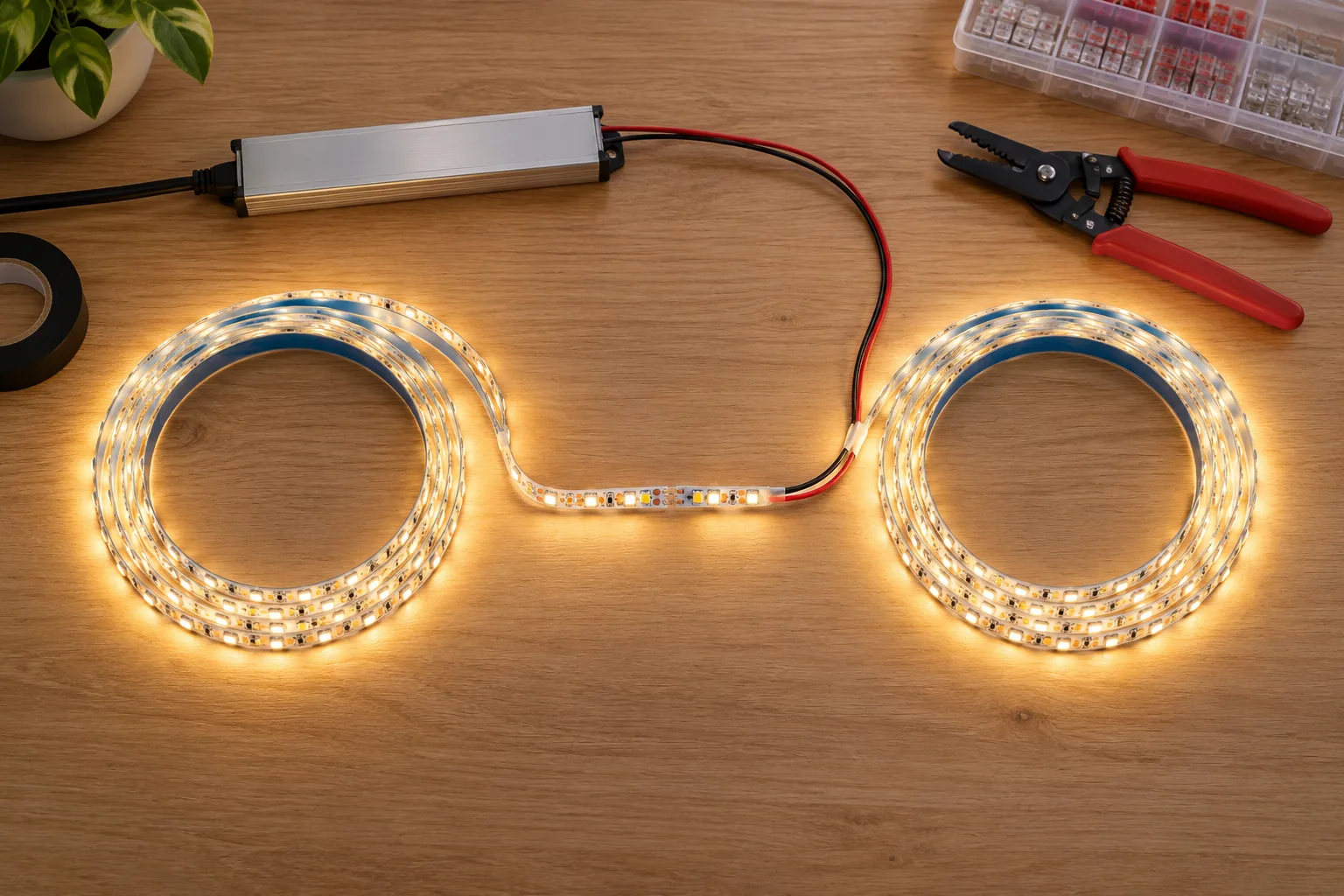
You can connect multiple LED strip lights together as long as they share the same voltage and the power supply can carry their combined load. Join short sections end to end with an LED strip connector, and feed longer or separate runs in parallel from the supply so each one gets full voltage.
- Can you connect multiple LED strip lights together?
- Should LED strips be connected in series or in parallel?
- Which LED strip connector should I use?
- How do I size the power supply for several strips?
- Can I mix different LED strips on one power supply?
- How do I connect multiple LED strips step by step?
- Why is one end of my connected strip dimmer than the other?
Can you connect multiple LED strip lights together?
Yes, provided every strip on the circuit runs at the same voltage and the total wattage stays within the power supply rating. A 12V strip must only be joined to other 12V strips, and a 24V strip to other 24V strips. Our 2835 LED strip is offered in a 12V version on 8 mm PCB and a 24V version on 10 mm PCB, so the two versions cannot share a supply and also need different connectors.
5V USB COB strips are a separate case. They take power from a USB port and usually come with their own lead and switch, so treat each one as a self-contained kit rather than adding it to a 12V circuit.
Should LED strips be connected in series or in parallel?
For anything beyond a short continuous line, connect strips in parallel: run a separate pair of wires from the power supply (or a distribution block) to the start of each strip. Joining strips end to end, often called connecting them in series, is fine for short sections, but every extra metre makes the current for all following sections pass through the copper tracks of the first one.
Those tracks have resistance, so the voltage falls along the run and the far end can look dimmer or slightly different in colour. Parallel feeds avoid this because each strip starts with full voltage. The maximum length that can be fed from one end depends on the strip, so check the strip's datasheet for its recommended run length before you plan an end-to-end layout.
Electrically, the LEDs on a constant-voltage strip are already wired in parallel segments, which is why you can cut the strip at the marked points and why parallel feeding is the natural way to extend it.
Which LED strip connector should I use?
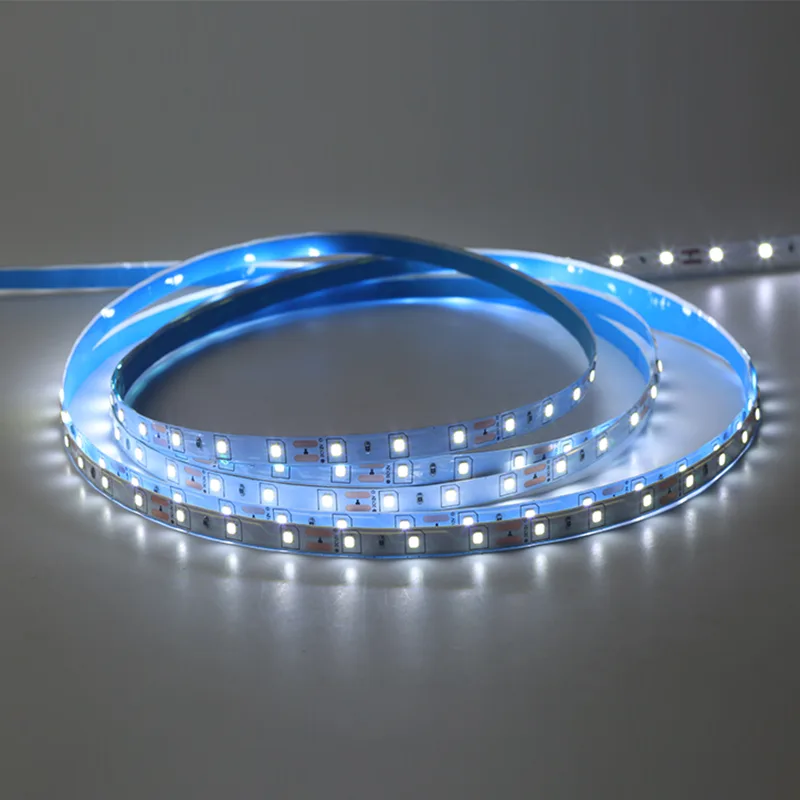
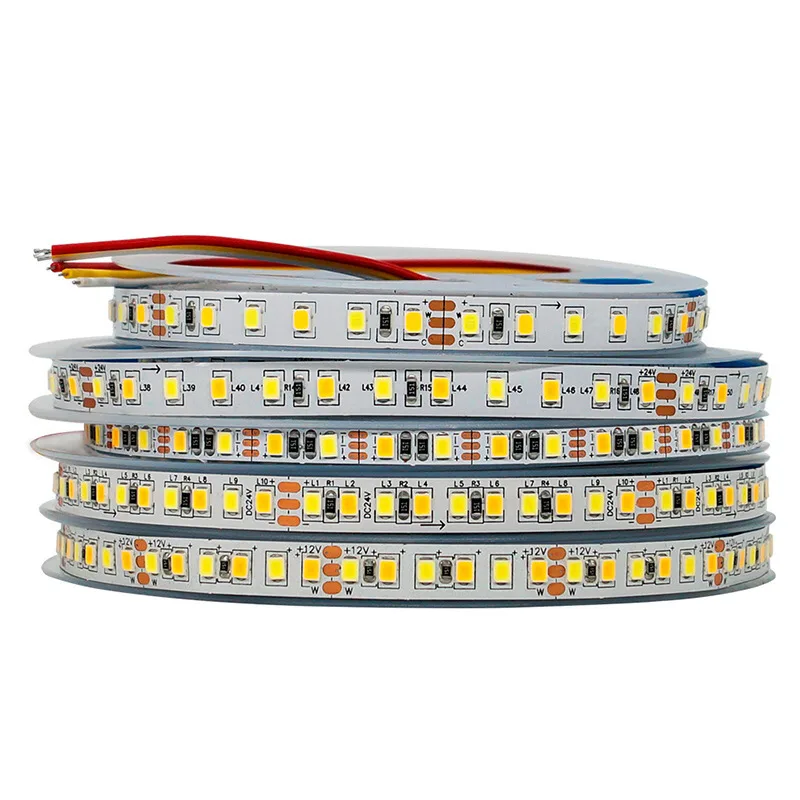
Use a connector that matches the PCB width and the number of conductors on your strip. An 8 mm strip such as the TSP-2835-60-8 or TSP-2835-120-8 needs an 8 mm connector; a 10 mm strip needs a 10 mm connector. A single-colour strip has two conductors (positive and negative), while a CCT strip has an extra channel and needs a connector with matching contacts.
The common types are strip-to-strip clips for straight joins, short jumper leads or L-shaped pieces for corners, strip-to-wire clips for feeding power in, and splitter leads for sending one supply output to several strips. Solderless clips are quick to fit; soldered joints with heat-shrink are more robust where the strip will be moved, bent or exposed to vibration.
Whatever you use, cut the strip only at the marked cut points, line the pads up with the contacts and keep the polarity the same at every joint.
How do I size the power supply for several strips?
Add up the watts of every strip on the supply, then convert to current. Strip power is watts per metre multiplied by length. For example, 5 m of TSP-2835-60-8 at 4.8W/m is 4.8W/m × 5 m = 24W, and 5 m of TSP-2835-120-8 at 9.6W/m is 9.6W/m × 5 m = 48W. Together that is 24W + 48W = 72W, and 72W ÷ 12V = 6A.
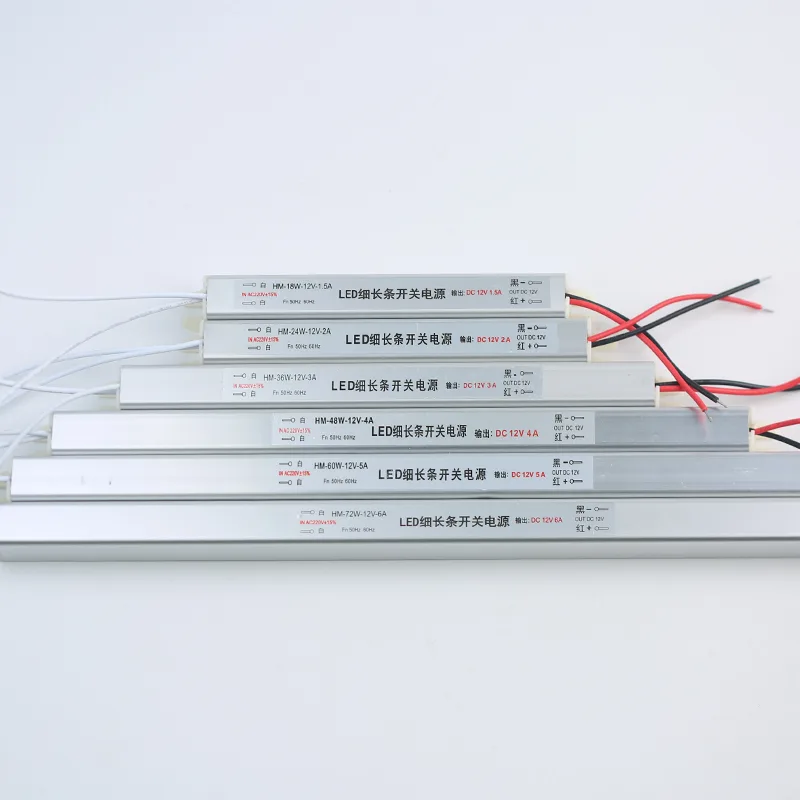
Our HM slim 12V supply is listed from HM-18W-12V-1.5A up to HM-72W-12V-6A. A 72W load on the 72W model would leave no headroom, so a better plan is to split the circuit: put the 24W strip on an HM-36W supply (36W ÷ 12V = 3A) and the 48W strip on an HM-60W supply (60W ÷ 12V = 5A). Check the supply's datasheet for its recommended continuous load rather than running it at its full rating.
Splitting a large installation across two or more supplies also shortens the low-voltage cable runs and keeps one fault from switching off every strip.
Can I mix different LED strips on one power supply?
You can mix strips on one supply only if they have the same input voltage; different LED densities, wattages and colour temperatures are electrically fine together. A 60 LEDs/m strip and a 120 LEDs/m strip at 12V can share a 12V supply as long as the total watts fit the rating.
The visual result is another matter. Strips with different LED densities, CRI or colour temperature will look different side by side, so keep the same strip model within any run that can be seen as one line of light.
How do I connect multiple LED strips step by step?
Plan the layout first, then wire from the power supply outwards. A typical sequence is:
1. Measure each run and multiply by the strip's W/m to get the total load. 2. Choose a supply, or several, with the correct output voltage and enough headroom. 3. Cut the strips at the marked points. 4. Fit connectors or solder leads, matching positive to positive. 5. Run a separate feed from the supply to the start of each longer run, or use a splitter lead. 6. If you use a switch or dimmer, place it between the supply output and the strips and check its rated load against the total. 7. Connect the DC side, then have the mains side connected and power up.
Before fixing the strips in place, switch on and check every section lights evenly from start to end.
Why is one end of my connected strip dimmer than the other?
Uneven brightness along a connected run is almost always voltage drop. The cause is too much strip fed from one end, thin feed wire or a poor connector contact.
To check it, measure the DC voltage at the start and at the far end of the run with the lights on. If the far end reads noticeably lower, add a parallel feed to the far end or to the middle of the run, use a heavier feed cable, or remake the joint that shows the drop. If only one section is dark or flickers, reseat or re-solder the connector at the start of that section and confirm the polarity is correct.
Safety: the AC side of any LED power supply runs at mains voltage (110-240V). Switch off and isolate the circuit before working on it, and have the mains connection made by a qualified electrician. Only the DC output side should be handled during the low-voltage wiring described here.
Figures are from our product listings or worked out from them. Check the specific model before installation.
Parts to use
 TSP-2835-60-8
 12V 2835 LED Strip, 60 LEDs/m, 4.8W/m
 TSP-2835-120-8
 SMD2835 LED Strip with Remote, 12V 9.6W/m
 Featured
HM Slim 12V LED Power Supply, 18W to 72W, 220V AC Input
 2835
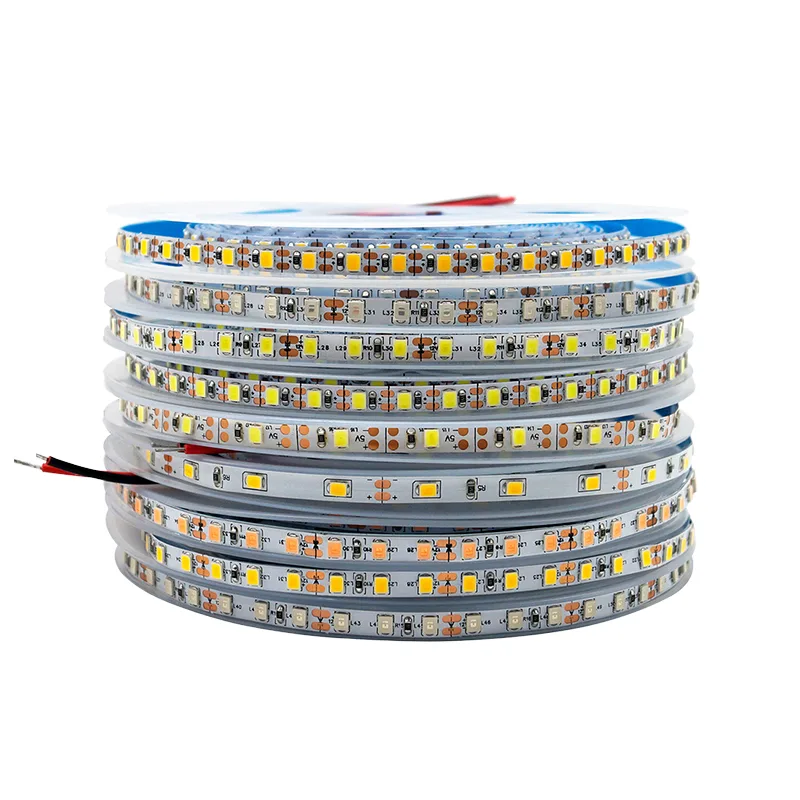
2835 LED Strip, 60 or 120 LEDs/m, 12V 8 mm or 24V 10 mm
Tell us what you are building
Send the switch type, voltage, load and quantity, or a photo of the switch you use today. We reply with model options, MOQ, price and lead time.